-
RSS feed

Water – Another View

by Doug Pushard based on article published in Green Fire Times, February 2010

In a recent article I reviewed our growing population and the declining precipitation rates that the northern New Mexico (see related link) area has experienced over the past several decades. This paints a very arid picture indeed for this part of the country. Pumping more water or increasing water transfer from other areas is not going to solve this problem. Increased pumping and transferring water from further locations increases the need for more power generation and this directly translates into more power plants. For those of us who love our amazing vistas and crystal clear blue skies, the solution to our water needs can’t involve polluting our skies. Clearly, we must look to other solutions to solve our water needs.
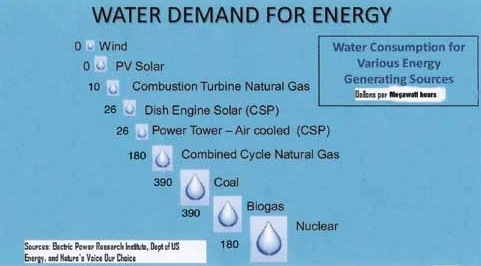
No matter how much pollution control equipment is installed, traditional power plants still pollute. Another less realized fact is that power plants consume vast quantities of water. An average coal plant will consume 390 gallons of water for every MWh (megawatt hour) generated. The proposed Desert Rock Power Plant built on a 580-acre site on the Navajo Nation, San Juan County, New Mexico is a 1,500-megawatt (MW) coal-fired plant and is projected to produce 211,000 to 375,000 megawatt-hours of electricity per year. This hotly contested plant is projected to emit 12-13 million tons of CO2 and consume over 1.6 billion gallons annually or 438,000 gallons a day!

There is no free lunch when it comes to power generation. All types will require water, either during operations or during the manufacturing process. Wind and small distributed photovoltaic solar systems use virtually use none to operate, while nuclear and coal use prodigious amounts of water. However, manufacturing solar panels or wind turbines do require water, but recent studies show it is not extensive amounts.

Traditional power generation and distribution literally use tons of water each and every day. Water and energy usage are inextricably linked. Conserve one and it conserves the other, consume one and it consumes the other. The most direct way to prevent a kWh from needing to be generated or a gallon of water from being pumped is not to use either in the first place – conserve, don’t consume.

A National Resource Defense Council (www.nrdc.org) study concluded that there are more than 60,000 water systems and 15,000 wastewater systems in the United States and are among the country’s largest energy consumers, using about 75 billion kWh/yr nationally—3 percent of annual U.S. electricity consumption to treat and deliver water. This demand alone is equivalent to the entire residential demand for the state of California. If San Diego relied on water conservation instead of additional water from Northern California to provide the next 100,000 acre-feet of water, it would save water and enough energy to provide electricity for 25 percent of all of the households in San Diego.

Although buying and installing large cisterns and/or a photovoltaic tracking array may be sexy – they both consume resources. It is far better for the environment and your pocket book to start with conservation. To get the biggest bang, be extremely aggressive on water conservation. It saves water but it also saves energy, which in turn saves water.

Albuquerque and Santa Fe both have good water conservation programs; Albuquerque since 1995 and Santa Fe since 2002. Both cities have significantly reduced per capita water consumption with the introduction of these programs. These cities and others realize conserving water is the way of the future.

These programs have saved massive quantities of water, and consequently tons of CO2 emissions. Other cities in the US have come to realize that these normally small, isolated, “liberal environmental programs” can be part of the solution to other, much larger problems.

A great example is James City County (JCC), Virginia. The county knew that as the area grows, so does the demand for water. Between 1990 and 1999, JCC's population grew 33.5 percent, from 36,309 to 48,475. To meet that growth, JCSA's groundwater withdrawal had increased from 600 million gallons per year to over 1 billion — a 50 percent increase. In the first year of its aggressive water conservation program the county replaced just 0.15% of high-water use appliances owned by customers and saved 6 million gallons of water.

The program involved installing rain sensors, rain barrels and cisterns, high efficiency toilets, high efficiency washing machines, on-demand hot water recirculators and high efficiency dishwashers. For this program, the EPA recognized JCC as a WaterSense Water Efficiency Partner of the Year.

The county quickly determined that by increasing the replacement of low water use appliances from 0.15% to 25%, the county could meet over 50% of future water demands while at the same time reducing by 2,590 tons per year of CO2e (i.e. carbon dioxide equivalent) that would have been produced if the water was not saved.

Chicago is another city with a similar, yet even more aggressive and integrated water/energy management program. Chicago’s goal is to reduce CO2e by 98,000 MT by 2020 through a Green Infrastructure Program. Components of this program include aggressive replacement of aging, leaking infrastructure as well as programs to promote disconnecting downspouts from city stormwater system and directing this “waste water” to rain barrels, cisterns, rain gardens. Other programs include promotion of green roofs and replacing normal asphalt with green paving to reduce storm runoff. Permeable alleys and rain gardens reduce flooding, and use rainwater as a resource to beautify neighborhoods. These programs have been promoted through community meetings, instructional video tapes, brochures and discounts on materials to homeowners. The city already requires all public buildings be constructed to meet LEED criteria, and this has been in place for a number of years and is actively working to require specific water conservation approaches be mandatory on all other future buildings

Average Daily Water Use Per Person

Albuquerque (1995) 250 gallons
Albuquerque (2008) 161 gallons
Santa Fe (1995) 250 gallons
Santa Fe (2007) 100 gallons
US Average 150 gallons
UK Average 40 gallons

The United States is no alone in the drive to conserve. Even more dramatic is the program implemented in Queensland, Australia. Australia’s fastest-growing state, with 2.7 million residents, Queensland Water Commission asked that residents use just 35 to 40 gallons of water per person per day -- a savings that could be more easily attained if residents reduced their seven-minute showers to four minutes. The message was widely advertised on television and in outdoor advertising. Queensland also implemented a major rebate program that provided its residents with over 500,000 water-saving devices, including rainwater tanks, low-flush toilets and water-efficient shower heads. The result was it didn’t just meet the stated goal - but exceeded it.

Rebates and education were substantial parts of the program in order to meet this objective. High efficiency showerhead were given away and rebates for cisterns could nearly pay for the tank (i.e. close to $1 a gallon) if the tank was plumbed to supply both water for outdoor irrigation and indoor toilets.

Cities around the country and world are discovering water conservation, but also the direct link between water, energy, and CO2 emissions. Aggressive water conservation programs (i.e., larger incentives, increased awareness programs, etc.) can be part of the solution to help us address even larger issues (i.e. future water supply needs, ease growth constraints, decreasing air pollution, etc.). It is not just the water - it is our clear blue skies we should also care about. Please help conserve our most precious resource. The solution starts with each of us doing what we can.

Related Links

Water: Why Care Article
Energy Water Relationship: Copenhagen Presentation
Green Fire Times
City of Chicago
James City County (JCC), Virginia
City of Santa Fe
City of Albuquerque
US Water Use
Worldwide Water Use

TOP

HOME


SITE NEWSLETTER
Sign up for updates:

SITE SPONSORS

Conservation Technology

RMS

Xerxes Corp

WATER NEWS

July 2010

The carbon footprint of tap water

Index Rates Nations Facing 'Extreme' Water Security Risks

Consumers Save Money, Water with EPA's WaterSense Program

Study Finds Dry Cities Have Cheap Water

June 2010

Water is Life! >> more

EPA Proposes Updating Drinking Water Rule to Better Protect Public Health >> more

Thirsty? Try a glass of skywater >> more

Discovery May Lead To Safer Drinking Water, Cheaper Medicine >> more

EPA is proposing to revise the 1989 Total Coliform Rule >> more

When Water and Energy Collide >> more

Upper Delaware Named America's Most Endangered River >> more

NASA Satellite To Help Monitor Water Consumption >> more

Is Water Running Out? >> more

May 2010

Water-Related Conflicts Set To Escalate >> more

Safe on-Site Reuse of Greywater for Irrigation - A Critical Review of Current Guidelines >> more

America's Thirstiest Cities >> more

April 2010

Ace Roto-Mold Introduces New Low Profile Cistern Tanks >> more

Novato offering rebates to residents to conserve water >> more

March 2010

DENR urges adoption of rainwater harvesting >> more

Coca-Cola expands water partnership with USAID >> more

Future Water Supplies Seriously Challenged >> more

Chino Valley looking at RWH ordinance >> more

Saving U.S. Water and Sewer Systems Would Be Costly >> more

EPA rates showerheads >> more

Wasting water may land you behind bars >> more

Illinois rainwater harvesting bill passes first hurdle >> more

Utah OKs rainwater harvesting >> more

Stopping Household Leaks Can Save Enough Water to Sustain Colorado Consumers for Nearly Three Years >> more

February 2010

Dual-flush fixtures offer significant water savings >> more

Free market water - the impact >> more

Water rates continue to rise >> more

January 2010

Job creation potential from rainwater harvesting cannot be ignored >> more

New immigrant looks to make rainwater harvesting popular >> more

Australian water crisis offers clues for California >> more

As temperatures fall, taps dry up >> more

'Put rainwater harvesting in new homes' >> more

America's Dwindling Water Supply >> more

IPS considers challenges of rainwater harvesting >> more

Rainwater Harvesting Systems for high water tables and shallow excavation areas >> more

It’s legal to collect your own rain >> more

December 2009

Survey Finds Virtually All Building Professionals Concerned about Water Conservation >> more

Experiences with Rainwater Harvesting & Greywater >> more

EPA Releases First-Ever Baseline Study of U.S. Lakes >> more

Water And Energy Nexus Critical To Climate Change >> more

APMO GTC finalizes green supplement >> more

Paying for water with power >> more

Report focuses on role of water, rainwater harvesting in sustainable design >> more

HGCD committee approves conservation plan >> more

November 2009

Agriculture can adapt to climate change >> more

EPA Issues Rule to Reduce Water Pollution from Construction Sites >> more

A Comparison of Bottled and Tap Water Using Life Cycle Analysis >>more

ONGC in India makes rainwater harvesting compulsory >> more

Top 5 Green Building Products for Homes at GreenBuild 2009 >> more

tru2earth makes the tru2earth Life Cycle Roof Tile >>more

EPA Cites 14 Municipalities For Stormwater Violations >>more

It's Raining Money >>more

Council OKs landscape code, includes Rainwater Harvesting >> more

Rainwater Is Safe To Drink >> more

Collection systems are simple, cheap and easy to put together >> more

For millenniums, Yemen preserved traditions of rainwater collection and shallow wells >> more

More Water Rate Increases on the Way >> more

California lawmakers pass historic water package >> more

Americans Using Less Water >> more

Foothills man retrofits home to use rainwater >> more

Conserving soil in the wake of climate change >> more

October 2009

Soggy spots can prove a valuable resource >> more

Up on the roof tops- green and growing >> more

Washington State clarifies muddy rain collecting law >> more

High schools to integrate rainwater harvesting in science curriculum >> more

Chloride in Groundwater and Surface Water >> more

New ARCSA and American Society of Plumbing Engineers (ASPE) Rainwater Catchment Design and Installation Standards >> more

Breaking ground with a $1.6 billion plan to tame water >> more

Rain Shocked >> more

September 2009

Rainwater Harvesting and Energy Use study by NRDC >> more

Why Climate Change Makes Riparian
Restoration More Important than Ever >> more

August 2009

Santa Fe Offers Rebates >> more

CA Residential 'gray water' rules eased >> more

Goodbye Pools, Lawns and a Whole Lot More >> more

EPA Offers Water Saving Tips >> more

A First for Rainwater Harvesting >> more

One Size Doesn't Fit All >> more

---------------------

July 2009

Texas Scorched by Worst Drought in 50 Years >> more

Los Angeles Invites Residents and Businesses to Participate in City's New On-Site Rainwater Harvesting Program >> more

Future Of Western Water Supply Threatened By Climate Change >> more

New law legalizes rain catchment >> more

Rain barrels turn into art >> more

New law legalizes rain catchment >> more

E=H2O >> more

Water Needs Electricity Needs Water >> more

Rising trend of short but intense spells of rainfall is making usable water scarce in India. >> more

Major project under way beneath new Gates Foundation >> more

Multinational company goes for rainwater in big way >> more

CO allows limited RWH, changes 120 year old law >> more

Southern Nevada Water Authority continues to block serious water management plans >>more

Graywater Primer >> more

Graywater study results can't be processed fast enough >> more

$260M in economic recovery investments to help California >> more

De-Watering Wyoming >> more

Lawton water rates could go up 75 percent >> more

What's In Your Water?: Disinfectants Create Toxic By-Products >> more

Changing climate will lead to devastating loss of phosphorus from soil >> more

LA Latest to Raise Rates >> more

Water Worries Shape Local Energy Decisions >> more

Nitrate levels high in drinking water due to lack of rain >> more

Water Quality of Potential Concern in US Private Wells >> more

Catching Raindrops Can Make You an Outlaw>> more

As climate changes, is water the new oil? >> more

New watering source is surfacing >> more

Forum Moves Water Higher Up Global Priority List > > more

UN Warns Action Needed to Prevent Water Crisis > more

Santa Fe water rates go up and up >> more

Rainwater Irrigation for Golf Courses>> more

Rainwater harvesting on a growth spurt.>> more

Yet Another 'Footprint' to Worry About: Water >> more

Water rates may go up by 700 percent >> more

Las Vegas running dry >> more

AQUIFERS IN DECLINE >> more

New Video: Reduce Runoff: Slow It Down, Spread It Out, Soak It In >> more

AQUIFERS IN DECLINE >> more

Buena Park water rates will go up 20% next month >> more

Rainwater could save BISD big bucks >> more

EPA Releases Rainwater Harvesting Handbook >> more

AWE Signs Historic Memorandum of Understanding
Forming a Water Efficiency Research Coalition >> more

Significant Purity Differences among Leading Brands of Bottled Water >> more

Bush Administration Covered Up 500+ Blocked Water Pollution Cases >> more

AWE Advises Obama's Transition Team on Investment in Water Efficiency >> more

The High Cost of High Pressure >> more

Pennsylvania American Water today
requested that customers voluntarily reduce water consumption by 5 percent
>> more

San Diego Homeowners to get a Water Budget >> more

Warming to cut Colorado water supply>> more

Green Roof Study Finds Vast Performance Differences for Cooling and Water Handling Abilities>> more

More rate increases on the way>> more

Cactus Goo Makes Water Safe >> more

Rainwater harvesting saves water, breaks the law >> more

Starbuck's with Water to Burn>> more

RainTube and Rainwater H2OG form alliance to market innovative Rainwater Rescue solutions>> more

Australia desal and water tank wars >> more

New Virtual Water Study attempts to measure water foot print >> more

Penn State Public Broadcasting Documentary on Nation’s Deteriorating Water Infrastructure >> more

City enacts strongest water restriction ever >> more

Spain may be a glimpse into our conservaton future >> more

Alta, Utah sees 25% rate rate >> more

Energy is Water >> more

PRIVACY: We will not sell, rent or share your name with anyone. see policy

FAQS

1. How do you harvest rainwater?
2. Where do you get the water?
3. What is the best way of harvesting rain?
4. Why should I harvest rainwater?
5. Do I need pumps to harvest rainwater?
6. Can I use drip irrigation or soaker hoses with a rainwater?
7. How big a yard can I water?
8. How big are rain barrels?
9. I want more pressure, how should I raise it?
10. Can I water my grass with rainwater?

and many more>>


Copyright © 1990-2010 HarvestH2o, LLC. All Rights Reserved