|
Potable Rainwater: Filtration and Purification
by Doug Pushard
 When I was growing up, I remember drinking out of a rain barrel with a ladle. My great aunt would yell out the door, “Remember not to drink off the top!” That was then and now is now. When I was growing up, I remember drinking out of a rain barrel with a ladle. My great aunt would yell out the door, “Remember not to drink off the top!” That was then and now is now.
A lot has changed in 4 decades. There are a lot more pollutants, and we are more aware of the risks. We now know that E. coli and other harmful bacteria can be passed along in untreated contaminated water. A report by Peter H. Gleick estimates that if no action is taken to address unmet basic human needs for water, as many as 135 million people will die from water-related diseases by 2020.
Rainwater harvesting is viewed by many, including the EPA, as a partial solution to the problems posed by water scarcity: droughts and desertification, erosion from runoff, over-reliance on depleted aquifers, and the costs of new irrigation, diversion, and water treatment facilities.
Harvested rainwater in the U.S. is used mostly for irrigation; however, there is a growing interest in using rainwater for drinking and other indoor uses. Over 50% of household water is used indoors; bringing rain indoors could save the expense and environmental costs of treating and transporting water.
Can rainwater be made safe to drink? Yes. How safe? As safe as your well or tap water. How do you make it safe for indoor use? By filtering and purifying it.
Contaminants in water may include algae, air pollution, bird excrement, and leaves, sand, and dust. Local wells have dealt with these problems for decades. Installation of filtration and purification equipment can remove these contaminants at home as well.
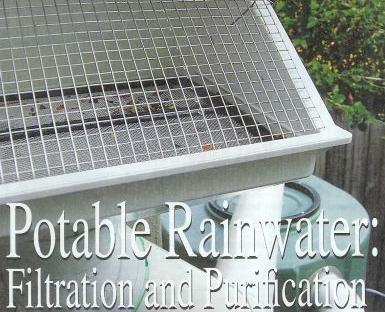
First, take measures to keep foreign matter out of the incoming rainwater. First flush devices, gutter screens and other screening mechanisms keep the rainwater as clean as possible before it enters the conveyance system. Using screens and filters will greatly reduce maintenance and lengthen the life of the pump and filtration/purification system.
Even the best screening systems will allow unwanted particulates into the cistern. To keep sediment where it belongs, at the bottom of your tank, screen incoming rainwater, give the remaining sediment time to settle, avoid disturbing it, and don’t pull water from the bottom of the tank. Use a floating filter, which extracts water from the middle of the tank, leaving sediment undisturbed.
Next is filtration, which removes debris from the water. Disinfection or purification follows, which kills contaminants and removes harmful substances that may be present.
To determine what type of system you need, test the rainwater at a reliable laboratory. Without testing, you could spend a lot of money on equipment that will not give you safe water.
Filtration is included in every system, even simple irrigation systems. Examples of filtration systems include: screen filters, paper filters, and carbon or charcoal filters.
Almost all systems use multiple filters. For example, after gutter screens and/or a first flush device, a system often includes two in-line filters of increasing fineness, a carbon filter and a UV light. Each of these are described below to assist you in evaluating what might be the right alternative for your planned water use and required water quality.
In starting to evaluate filter options, it is imperative to know exactly what the filter system you select will actually remove from the water. National Sanitation Foundation/American National Standards Institutions (NSF/ANSI) standards are the best, most stringent in the industry. Almost all water-filtration products are certified under NSF Standard 61 for Drinking Water System Components (see Related Topics). But the critical standards for contaminant removal are Standard 42, “Drinking Water Treatment Units – Aesthetic Effects,” and Standard 53, “Drinking Water Treatment Units – Health Effects."
Standard 42 covers specific aesthetic contaminants (chlorine taste and odor, and visible particulates). Standard 53 covers health-related contaminants, such as Cryptosporidium, Giardia, lead, and volatile organic chemicals that may be present in drinking water. Systems that meet both of these standards are available, but expensive. Fortunately, the NSF website (see Related Topics) provides an easy way to search for units made by a specific manufacturer or that remove a specific contaminant.
Filters and Disinfection
Filters are measured in microns. One micron is about 1/25,000th of an inch. For comparison, sand is about 100 – 1,000 microns, a human hair is about 100 microns, a particle of dust is about 1 micron and a virus can be smaller than .01 micron.
The first filters in a system are cartridge filters. They range widely in what they are capable of removing and are used in a series (e.g., a 20 micron followed immediately by a 5 micron filter).
Filters are rated by the smallest size of particle they are capable of filtering. The smaller the micron size the better the filter. However, the finer the filter, the higher its cost and the slower its process. Filters have to be changed regularly, as an old, used filter is an excellent environment for microorganisms and potentially harmful pathogens.
For wells and rainwater systems a larger (e.g., a 50 micron) filter or equivalent screen (e.g., 300 mesh) should be used first to eliminate sand and large particles. This screen should be easily accessible and cleaned quarterly. Next is a 20 or 10 micron filter, followed immediately by a 10 or 5 micron filter. These are cleaned less frequently, but at least annually.
Filters will not eliminate all substances in the water. To create drinking quality water, filtration is always followed by disinfection. The EPA requires surface and ground water to be disinfected before it is consumed. Consequently, public water systems add disinfectants to destroy microorganisms that can cause disease in people and animals.
This is also necessary for rainwater, as the natural environment contains many microorganisms. Most are not harmful to us. Some, however, such as Giardia lamblia, can be deadly. These need to be eliminated from water before it is consumed.
Kinds of disinfection include chlorinization, ozonization, ultraviolet (UV) light, and membrane filtration. In evaluating disinfection methods, be aware that some actually create unhealthy byproducts that need to be treated.
The effectiveness of disinfection is judged by looking for an indicator organism that, if present, indicates other more harmful pathogens may be present. In getting a water test, this indicator organism is Total Coliform Bacteria that, if present, indicates other pathogens may be present as well.
Chlorine has been used as a disinfectant in public water systems for most of the past century. The introduction of chlorine to disinfect water has virtually eliminated waterborne diseases such as cholera, typhoid, dysentery and hepatitis, saving thousands of lives. However, it is often maligned due to suspected side effects.
For disinfection purposes, 2.3 fluid ounces of household bleach must be added per 1,000 gallons of water. Chlorine dosage rate will vary depending on quantity of water to be treated, pH and temperature.
A major downside of chlorine is that it is very reactive and easily combines with naturally occurring organic material to create harmful trihalomethanes (THMs) like chloroform. Chloroform is formed when chlorine reacts with either humic and/or fulvic acids, which are commonly found in water.
Because chlorine is reactive, it quickly dissipates. Keeping the dosage rate correct is critical when using this method of disinfection. THMs should be tested for in the water source if you are going to use Chlorine.
To reduce the possibility of harmful byproducts with the use of Chlorine, do the following:
- Remove the byproducts after they have been created. This is costly, typically meaning other purification systems must be employed (e.g., Reverse Osmosis or other purifcation systems) or
- The concentration of particulates/organics in the water before it is treated. This is accomplished by using filters to remove these substances from the water prior to chlorine treatment.
The Chlorine smell and taste can be removed with an activated carbon filter, often referred to as a charcoal filter. Granulated activated carbon filters are sometimes made from coconut shells and can be considered a “green” solution. Carbon block filters are compressed activated carbon, fused with a binding substance into a solid block.
Ultraviolet Light
An alternative for disinfecting water is Ultraviolet (UV) light. UV lights have been used for nearly a century in Europe and are now common in the US. With UV lights, the water must always pass through a filtration system first. If no filter is used, pathogens and bacteria will cast shadows in the flowing water, thereby allowing live organisms to pass through unharmed.
UV light works by penetrating an organism’s cell walls and disrupting the cell’s genetic makeup, making it impossible to reproduce and rendering it harmless. Often it is claimed that it kills the microorganism, but it doesn’t - it just makes them unable to reproduce and thus harmless. UV lights do not change the chemical composition of the water and leave behind no by-products.
For UV to be effective the right light dose must be used to a specific unit of water and the water must be clear of suspended solids and other particulates. Most UV units are usually insensitive to temperature and pH differences in the water, but manufacturers’ fine print should be read and followed.
There are several issues with UV lights should be taken into consideration:
- Replace the bulb at the manufacturer’s specified intervals – generally after 9,000 hours, or about every 12 months;
- UV light is not visible to the human eye, so it may appear to be lit and in fact is not working;
- The glass enclosure around the light needs to be cleaned occasionally for the UV light to be effective;
- If no backup light is installed the water needs to be shut off upstream of the bulb prior to replacing the unit. Generally it is prudent to disinfect the water downstream after the system has been shut down for any reason.
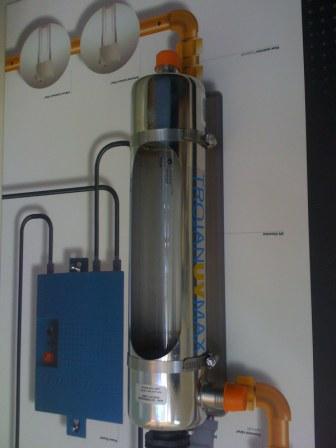 Correct UV treatment is effective in reducing harmful pathogens from the water. It is generally recommended that home units include alarms to notify the user when a bulb needs to be serviced or the unit is not working. Purchase a unit that has an automatic bulb cleaner, to reduce maintenance requirements. Two units should be installed, so when one unit needs servicing the second unit can be turned on so there is no disruption in disinfecting the drinking water. Correct UV treatment is effective in reducing harmful pathogens from the water. It is generally recommended that home units include alarms to notify the user when a bulb needs to be serviced or the unit is not working. Purchase a unit that has an automatic bulb cleaner, to reduce maintenance requirements. Two units should be installed, so when one unit needs servicing the second unit can be turned on so there is no disruption in disinfecting the drinking water.
UV light manufacturers rate their systems to a given dosage at a given flow rate (e.g., 10 gallons per minute). When installing a UV light, make sure the flow rate of the UV unit is matched to your flow rate of water (i.e., the pump flow rate). If the pump rate is greater than that of the UV light, install a pressure regulator or flow restrictor.
To properly treat the rainwater, it must contain particulates no larger than 50 microns and contain no tannins, sulfur or sulfur-related bacteria, have less than 0.3 parts per million of iron, and less than 0.005 parts per million of manganese. Knowing whether these are in the water and need to be treated is a great reason to test your water before installing a system. If any of the above is present in the water, the filters must deal with these elements before the water is treated by a UV light. Most of these will not be present in rainwater, but could result from local air pollution or contamination of the conveyance system. Don’t assume anything until your water has been lab tested.
The UV light unit is typically installed after all filtration and the resulting water is clean, bug-free and ready to use. Entry-level units will handle about 10 gallons per minute. The price of the unit will increase as options and flow rates increase.
Membrane Filtration
Membrane filtration is another alternative. Membrane filtration involves pushing water through a layer of material. Pressure-driven membrane technologies include microfiltration, ultrafiltration, nanofiltration and reverse osmosis. It is one of the few technologies capable of removing pharmaceuticals, and creates no byproducts.
Membrane technologies are more costly than other alternatives, but prices are rapidly declining. Most water purification experts expect membrane technology to become the prevalent technology in smaller systems over time as their price drops.
Choosing the right membrane technology is not straightforward, as the technology is changing and there are no real standards. Make sure you know what you need and match it to the type of system you are evaluating. Again, it is critical to test your water to know what you need before evaluating options.
Microfiltration (MF) is a membrane separation process using a pore size of .03 to 10 microns. Although this does not sound like a big range, when it comes to water purification, it is. The smaller the pore size, the more the system will remove. Microfiltration membranes are good for the removal of sand, silt, clay, algae, cysts and some bacteria.
Ultrafiltration (UF) is a membrane separation process using a pore size of approximately .002 to .1 microns. UF will remove all materials removed by an MF system, plus some viruses.
Nanofiltration membranes (NF) have an approximate pore size of only .001 microns. These small pore sizes require much more power to push water through the membrane and generate more waste than either MF or UF filtration systems. These systems eliminate virtually all cysts, bacteria, viruses, and other materials, including minerals. Consequently, the resulting water has a low pH that can be corrosive and needs to be remineralized, commonly using limestone, to raise the pH. Due to the greater power requirements, NF has yet to become mainstream.
Reverse Osmosis (RO) is the most widely used membrane technology today.  These systems remove particles as fine as .001 microns, are compact, simple to operate and have been in use for over a decade. RO systems remove radium, natural organics, pesticides, cysts, bacteria and viruses. To ensure contaminant reduction, seek out units certified by NSF for contaminant reduction and not just safety. RO systems produce waste water that needs to be processed; however, the newer units are becoming “greener,” producing less, but still significant, waste. These units vary greatly in their efficiency, so make sure to ask about waste and efficiency when shopping for an RO system. These systems remove particles as fine as .001 microns, are compact, simple to operate and have been in use for over a decade. RO systems remove radium, natural organics, pesticides, cysts, bacteria and viruses. To ensure contaminant reduction, seek out units certified by NSF for contaminant reduction and not just safety. RO systems produce waste water that needs to be processed; however, the newer units are becoming “greener,” producing less, but still significant, waste. These units vary greatly in their efficiency, so make sure to ask about waste and efficiency when shopping for an RO system.
RO waste water contains a high concentration of the contaminants removed from the water, so dealing with this waste must be planned for when installing an RO system. Options for dealing with this water include plumbing through a greywater system to the irrigation system or directly to the septic system.
RO systems come in small under-the-counter units or whole-house systems. Prices will vary greatly for these units and only NSF-certified units should be considered. Under-the-counter units generally include a sediment filter, a carbon filter, the RO membrane and another carbon filter, and will generally cost under $1,000. A whole-house unit contains all the same components, but is capable of handling much larger water flow rates, and generally includes a calcite or equivalent filter to reduce the pH of the water, and a large storage tank (e.g., 20 – 50 gallons). The cost of a whole-house unit can run upwards of $8,000, depending on size of the house and family.
Regardless of system size, maintenance needs to be performed regularly. The most frequent maintenance is changing cartridges. Filters are used to protect the RO membrane from particle fouling. As these filters trap particles from the water supply, a reduction in pressure occurs. Many RO units include a low-pressure switch that prevents the RO from running if the pressure drops too low. Check the allowable pressure drop across the cartridge and compare this to the incoming feed pressure. If it is lower than manufacturer recommendations, the filters need to be replaced.
Distillation
The last commonly available purification technology is distillation. Distillation separates the water from the impurities through heating and then collecting the condensation. It is very energy intensive and loses about 5-10% of the water due to evaporation. Distillation removes almost all substances from the water with the exception of volatile organic chemicals (VOCs) that evaporate easily. To this end, some distillation systems are also equipped with carbon filters to remove the VOCs.
Distillation works slowly to reduce energy requirements and, like RO systems, will store the purified water in a tank for later use. In addition to using a lot of electricity to operate, distillation systems generate heat.
Distillation units producing 5 -12 gallons of water a day will typically cost about $1,500 - $2,000. Cost will increase as capacity increases and as options are added. High-end automatic home units with larger storage capacity may cost upwards of $4,000. New solar distillers give you the option of reducing the electrical requirements.
Standard Practice for Household Use
A common practice in off the grid homes is to filter all the incoming rainwater and then store it in a small pressure tank. From the pressure tank the outgoing water is split into two separate paths - one path for potable and the other for non-potable water. A purification process is added to produce potable water. The major advantage of this approach is that it requires a much smaller unit and costs less, since it treats less water than a whole-house unit. But the disadvantage is that it requires a dual plumbing system – one to supply filtered but non-potable water to the toilets, clothes washer, irrigation faucets, etc., and one to supply potable water to the faucets.
An apparently low-cost, entry-level system is a countertop or pitcher type unit for potable water. However, when measured on gallons of water processed between changing filters, these units tend to be much more expensive in the long run. For example, a typical faucet unit available at most large hardware stores needs its filter changed every 100 gallons. For a family, this would be more than once a month and each filter costs about $30. This could cost nearly $500 a year, just for filters!
Before investing in filtration or purification equipment, invest in removing particulates before they enter into the system by installing gutter screens, leaf screens and roof washers. Removing materials before they enter the system is far easier and less expensive than dealing with them afterwards.
There is no perfect solution for disinfecting water, as all solutions have some environmental cost. Some require substantial energy, some create harmful by-products and some waste water. To save money, test your water (have you heard that before?) and get the right unit to solve your specific problem. Generally, the smaller the capacity the less expensive the unit will be overall, so get only what you need.
Lastly, remember that as the owner of a water system, it is your responsibility to maintain it. When you pay for utility-purified and -delivered water, maintenance is included in your bill. But when you own your water system, it is your responsibility to maintain it on a regular basis.
Rainwater can be safely used outdoors and indoors if the correct steps are taken to handle, store and clean it. Although not yet common in the US, indoor use of rainwater is practiced worldwide. As population growth continues, water rates increase and the desire to be “more green” and self-reliant increases, rainwater use will become more common here in the United States.
Links:
TOP
HOME |


