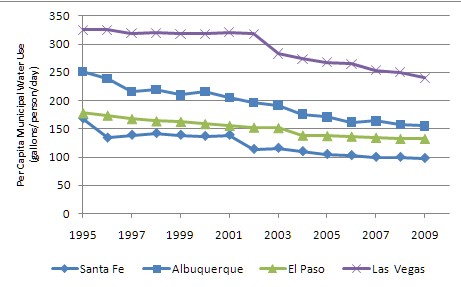
One of my good friends, Pete Garcia, always complains about
Santa Fe water rates. "We have the highest water rates in the country," he
says. Well, Pete, I hate to say it, but that is just about correct. Our base water rates aren't the highest in
the country, but as our tiered and summer water rates schedule kicks in, we do
have some of the highest rates. Yet compared to other cities in the world, our
water is still downright cheap.
In almost any place in the United States, we simply turn on the
faucet and it flows. This amazing infrastructure was built over the last
century and has supplied us cheap, plentiful water for decades. Abundant water,
cheap electricity and a great road system have been the backbone of our economy
over the last century. However, access to cheap, plentiful water is becoming a
thing of the past, not only in the Santa Fe area, but around the country and
the world.
In the United States, we are fortunate to have accessible
clean water at any price. Over 46% of the earth's population doesn't, and
people in developing countries walk an average of 3.7 miles to get access to
water. One in eight people on the planet lack access to clean water.
Access to an additional water source has been the main
driver for Santa Fe's multi-year water rate increase (i.e., 8.2% annual
increase from 2009 - 2014). Our local
Buckman Direct Diversion (BDD) project is estimated to cost more than $200
million and will provide both the city and county access to 5,605 acre-feet of
San Juan-Chama Project water per year (an acre-foot is approximately 325,851.4
gallons).
This water is more expensive than water pumped out of the
ground or piped in from local reservoirs. But even this source will not provide
us with all the water we will need in the future. We live in a high desert,
arid region and simply do not have enough drinking water to meet our growing
needs. Per the City of Santa Fe Water Conservation and Drought Management
Report, we are over-pumping the groundwater wells resulting in damage to the
underground aquifer. Even in the best of years, the Santa Fe River reservoirs
can only supply about half of the water our region needs. In very dry years,
they cannot supply much water at all and emergency water restrictions have had to
be put in place.
Due to projects like this, in which water is accessed from
further away or it is of lesser quality and requires more processing, , water
rates are rising here and around the world.
Most cities are now facing similar challenges.
For example, the city of Las Vegas, Nevada, which has
historically enjoyed cheap water, faces the possibility that Lake Mead, the
city's prime water source, will run dry in 13 years if usage is not cut back.
The city's water agency, the Southern Nevada Water Authority, has undertaken a
$700 million project to dig a bigger pipe into the lake. Scott Huntley, a
spokesman for the agency, said they are concerned that the city is relying
almost entirely on Lake Mead for its water, and officials were seeking
alternate sources. Las Vegas is turning to rural counties to the north to
quench a thirst that the nation's largest man-made reservoir can't sustain.
Plans include drilling wells and building a $1-billion pipeline to tap rivers
and groundwater from neighboring rural counties. This will not be cheap water.
Comparing data in the recently released Black & Veatch
2009/2010 Water/Wastewater Rate Survey, -Santa Fe has the fourth highest rates
of the 200 hundred US cities included in the survey, behind San Diego, Seattle
and Baltimore, in descending order. This comparison is looking at Santa Fe's
rates for 3,500 gallons per month, not including sewer, connection charges,
taxes or any other fees or summer usage rates.
However, at 15,000 gallons per month or more, Santa Fe has
the highest rates of all the cities included in the survey. The City of Santa
Fe's tiered rate structure of $15.81 per 1,000 gallons consumed makes our water
cost almost twice as much as the nearest city: Austin, Texas.
For the cities included in the survey, the average cost of
water from 2001-2009 has increased at a rate two times that of the Consumer
Price Index (CPI). These rate increases are being driven by the increase in
energy prices, increased demand, aging infrastructure, and the distance and
water quality problems mentioned above.
In another study, the Global Water Intelligence (GWI)
published a survey of water rates in 261 cities worldwide. In that survey,
Santa Fe is not even close to the top, in fact, US water appears downright
cheap compared to other cities in the world. The lovely cities of Copenhagen
and Aarthus, both in Denmark, the price of water is more than $20.00 per 1,000
gallons versus $5.81 in Santa Fe [you said $15.81 two paragraphs up]. Other
cities that are by far more expensive are Paris, France; Gent Belgium and
Stuttgart, Germany -- all over $10.00 per 1,000 gallons. It is worth noting that
more than a few international cities provide water free or nearly free and
these cities are some of the largest water consumers.
In Santa Fe, we are blessed to have had a drought that
forced our hand to become much more focused on water conservation, to raise our
water rates, and to create a tiered rate system to motivate the biggest water
consumers to cut back. These forward-thinking measures are why we have enough
water today, and we should thank our city staff for this. Our city is now one
of the lowest water use cities in the United States. But even with all these
efforts, expect water rates to continue rising.
To avoid the highest water rates, conserve water to keep
your water usage below 7,000 per month from September to April and 10,000 per
month from May through August. Water is
not just a life-giving resource, it is also an economic engine. There is simply
no more plentiful "cheap" water; consequently, water conservation will remain
key to sustaining the beautiful area we live in.
Recent Comments